
How to Convert Your Airbnb into a Long-term Rental
Thinking of switching your San Diego Airbnb to a long-term rental? Learn the benefits, steps to transition, and how to secure reliable tenants.
San Diego has long been a strong market for short-term rentals, but for many owners, the math and the workload are starting to shift. Between stricter local rules, seasonal demand swings, guest turnover, and constant operational tasks, running an Airbnb is not always the most stable way to hold a rental property in the long run. For many owners, converting a short-term rental into a long-term lease is a smart way to reduce stress, create more predictable cash flow, and turn the property into a more reliable investment.
At Good Life Property Management, we have been helping local owners navigate San Diego property management since 2013. We are a licensed California real estate brokerage (DRE #01929564), we have served more than 1,000 San Diego property owners, and our team focuses on long-term residential rentals, not Airbnb or furnished short-term stays. That experience gives us a clear view of what it takes to reposition a property for long-term success, from pricing and preparation to tenant placement, compliance, and ongoing management.
In this guide, we’ll walk through how to convert your Airbnb into a long-term rental in San Diego, what legal and operational changes to plan for.
Table of Contents
Why Convert Your San Diego Airbnb to a Long-Term Rental?
Before diving into the "how," it helps to understand the "why." Here is why many San Diego investors are making the switch:
Strict STR Regulations
San Diego’s STRO ordinance has capped the number of short-term rental licenses available, particularly for whole-home rentals. If you missed the lottery or don't want to deal with the ongoing compliance and renewal fees, a long-term rental bypasses these STR caps entirely.
Predictable Cash Flow
Airbnbs are highly seasonal. A long-term lease guarantees a fixed amount of rent hitting your bank account on the first of every month, regardless of whether it’s the peak of summer or the middle of winter.
Lower Operating Expenses
Say goodbye to paying for weekly cleanings, restocking toiletries, high utility bills, and constant minor wear-and-tear repairs. In a long-term rental, the tenant typically covers utilities and basic upkeep.
Less Hands-On Management
You no longer need to be on call 24/7 for lost keys, Wi-Fi outages, or noise complaints from neighbors.
For more information, check out our guide on short-term vs. long-term rentals.
When Does an Airbnb Become a Long-Term Rental in San Diego?
In San Diego, your Airbnb is considered a short-term rental when guests stay for less than one month. The city is pretty specific about what counts as a “month,” too. It is based on calendar dates, not just the number of nights. For example, a stay from January 31 to February 28 counts as a month, but a stay from February 1 to February 28 does not. If you are renting the home for less than one month per guest stay, the property falls under San Diego’s short-term rental rules.
Once you start renting the property for one month or longer per tenancy, you are no longer operating it as a short-term residential occupancy under the city’s STRO framework. That is the point where your Airbnb starts functioning like a true long-term rental. In practical terms, you are not just changing the listing strategy, you are changing the kind of rental business you are running.
That distinction matters because the rules shift with it. San Diego’s Residential Tenant Protections Ordinance applies to residential renters and landlords in the city, and the city’s own tenant guide says those requirements do not apply to short-term residential occupancy. So when you move from Airbnb-style hosting to month-to-month or fixed-term leasing, your focus needs to shift toward long-term rental compliance, including lease terms, tenant protections, and landlord responsibilities under city and state law.
Now that we’ve covered the benefits and legal logistics, let’s discuss how to convert your vacation rental into a long-term investment strategy step-by-step.
Step-by-Step Guide to Transitioning Your Property
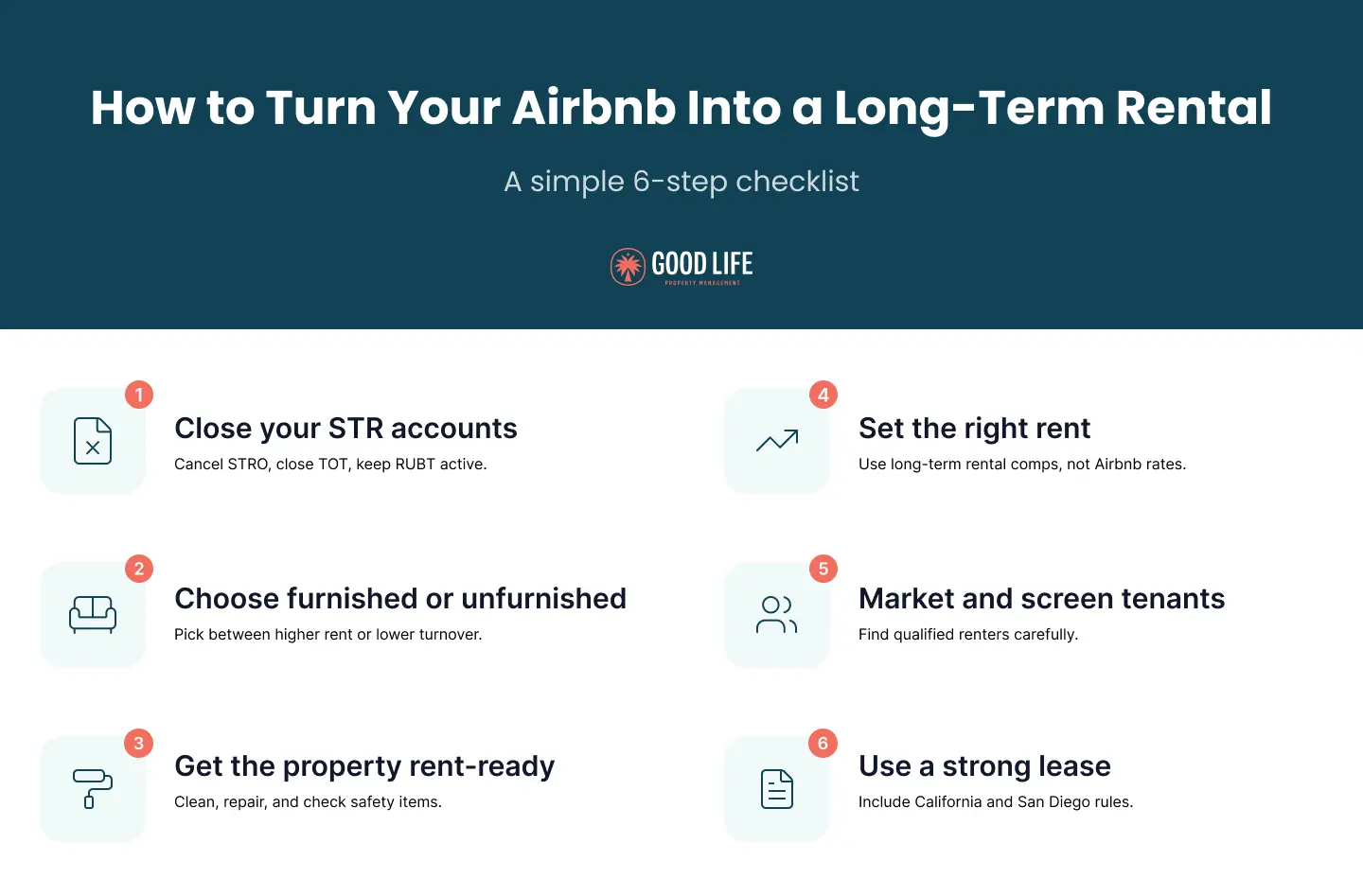
Making the switch requires more than just changing your listing online. Here are the steps to set yourself up for long-term success.
*** Click to enlargen
Step 1: Close Out Your STR Obligations
Transitioning out of the short-term rental market isn't quite as simple as just deleting your Airbnb listing. San Diego has strict regulatory and tax frameworks for STRs, and you need to formally close your accounts to avoid racking up unfiled return penalties or violating city ordinances.
Here is exactly what you need to do to cleanly exit the short-term market:
Honor or Cancel Existing Bookings
First, decide how to handle your calendar. If you have bookings months in advance, you can either block off future dates and let the remaining reservations play out, or cancel them immediately. Keep in mind that platforms like Airbnb and Vrbo impose strict financial penalties and algorithmic downgrades for host cancellations, so phasing out your calendar is usually the most cost-effective route.
Surrender Your STRO License
San Diego requires you to formally cancel your Short-Term Residential Occupancy (STRO) license. You cannot just let it sit unused. In fact, if you hold a Tier 3 or Tier 4 license, the city requires you to rent the property for a minimum of 90 days per year; failing to do so without canceling can lead to compliance issues.
How to do it: You must complete the city’s official STRO License Cancellation Form and email it to [email protected]. Keep in mind that license fees are non-refundable, but officially canceling frees up a highly coveted spot on the waitlist for another investor.
Close Your Transient Occupancy Tax (TOT) Account
As an STR host, you are registered with the City Treasurer to collect and remit the Transient Occupancy Tax (TOT) (which recently increased under Measure C, ranging from 11.75% to 13.75% depending on your property's tax zone). If you simply stop filing your monthly TOT returns, the city will assume you are delinquent and may hit you with late fees or trigger an audit. Contact the TOT Administration at [email protected] or call (619) 615-1530 to officially close your TOT certificate.
Keep Your Rental Unit Business Tax (RUBT) Active
Do not cancel your RUBT account! The City of San Diego requires all landlords—whether short-term or long-term—to pay the Rental Unit Business Tax. You will need to maintain this active account as you transition into a traditional 12-month lease.
Step 2: Decide whether you want to rent as Furnished or Unfurnished
One of the biggest hurdles for an Airbnb host transitioning to a long-term rental is deciding what to do with a house full of furniture. You’ve already invested time and money into decorating the space, so the idea of liquidating it can be daunting.
Before making a move, you need to decide whether you want to rent your property furnished or unfurnished. Here are pros and cons for each option:
Option A: Unfurnished (The Traditional Long-Term Lease)
This is the standard 12-month lease model. Tenants bring their own beds, couches, and decor to make the space their own.
- The Pros: Unfurnished rentals provide the ultimate stability. Because tenants invest the time and effort into moving all their personal belongings, they are significantly more likely to renew their lease and stay for multiple years. Plus, your maintenance costs drop dramatically—you are no longer responsible for repairing a broken TV or replacing a stained rug.
- The Cons: You have to empty the property. This means you will need to sell your inventory on Facebook Marketplace or OfferUp, donate it, or pay monthly fees to keep it in a storage unit.
- Best For: Investors who want a completely hands-off, "set it and forget it" approach with minimal turnover.
Option B: Furnished (The Mid-Term or Corporate Rental)
Instead of a traditional 12-month lease, you lease the property exactly as it is (pots, pans, and linens included) for terms typically ranging from 3 to 9 months.
- The Pros: You can charge a premium for a turnkey property. San Diego has a massive demand for mid-term rentals (MTRs) due to our strong local economy. Your target demographic includes traveling nurses working at UCSD or Sharp, military contractors on temporary assignments at Naval Base San Diego or Camp Pendleton, and corporate executives relocating for biotech roles in Sorrento Valley.
- The Cons: You will experience more frequent turnover than an unfurnished rental, meaning more time spent screening tenants and drafting leases. You will also experience higher vacancy rates between placements, and you remain financially responsible for the wear-and-tear on the furniture and appliances.
- Best For: Investors who want to maximize their monthly rental income and don't mind a slightly more active management role (or have a great property manager to handle the turnovers).
The Bottom Line: If you want absolute passive income and long-term security, clear the house and go unfurnished. If you want to leverage your existing furniture to command a higher monthly rent—and are willing to accept occasional vacancies—the mid-term furnished route is highly lucrative in San Diego.
Step 3: Deep Clean and Address Wear-and-Tear (and 2026 Habitability Standards)
Short-term renters are notoriously tough on properties. Vacationers dragging suitcases into walls, hosting unauthorized parties, or just treating your home like a hotel can leave a space looking tired. Before putting your property on the long-term market, you need to make it rent-ready for a long-term tenant and ensure it meets California’s stringent habitability laws.
Here is what you need to focus on during your turnaround:
Cosmetic Resets and Deep Cleaning
A long-term tenant will notice the things a weekend vacationer might overlook.
- Patch, sand, and paint scuffed walls and baseboards.
- Professionally deep clean all carpets and tile grout.
- Fix those lingering, minor maintenance issues (leaky faucets, sticky doors, running toilets, torn window screens) that you may have put off during a busy STR season.
Update Safety Equipment
California law is incredibly strict about fire safety, and a standard Airbnb setup might not cut it for a formal lease.
Smoke Detectors: You must have a working smoke detector inside every bedroom, in the hallway immediately outside the bedrooms, and on every level of the home. If they are battery-operated, state law mandates they must be 10-year sealed-battery units (you cannot use the old ones with replaceable 9-volt batteries).
Carbon Monoxide (CO) Detectors: If your property has an attached garage, a fireplace, or any gas appliance (furnace, stove, water heater), you are legally required to have CO detectors installed outside each sleeping area and on every level of the unit.
Comply with New 2026 Appliance Laws (AB 628)
If you are transitioning in 2026, you need to be aware of the newly implemented California Assembly Bill 628. This law explicitly adds working stoves and refrigerators to the state's legal definition of "habitability." Ensure your kitchen appliances are fully functional, safely generate heat/store food, and have no pending manufacturer recalls.
Verify Basic Habitability
Double-check that all core systems are functioning perfectly. The heating system must work, hot and cold water must run reliably, and the property must be entirely free of pests and mold. Unlike an Airbnb guest who might just leave a bad review if the heat goes out, a long-term tenant in San Diego has the legal right to withhold rent or "repair and deduct" if basic habitability standards aren't met.
Step 4: Set a Competitive Rental Rate (Navigating the 2026 Market)
Pricing a long-term rental is entirely different from setting a nightly short-term rate. The single biggest mistake transitioning Airbnb hosts make is looking at their peak July vacation revenue and assuming they can charge that same amount on a monthly lease. You cannot simply multiply your average nightly rate by 30.
Furthermore, the San Diego rental market in 2026 has officially shifted from a hyper-competitive landlord's market into a more balanced, normalized landscape. With average rents stabilizing (currently hovering around $2,800 to $3,000 citywide depending on property type), renters are becoming more price-sensitive and selective.
Learn more about pricing your long-term rental with our free and instant rent estimator.
Step 5: Market the Property and Screen Tenants
Finding a reliable tenant is the single most critical step in transitioning your Airbnb. A problematic tenant can cost you thousands of dollars in unpaid rent, property damage, and legal fees—far outweighing the sting of a slow month on Airbnb.
Because California law heavily favors tenant rights, you cannot afford to make a mistake during the placement process. For more information, check out our article on how to screen tenants for a rental property.
Step 6 Draft a Rock-Solid California Lease
California has arguably the most complex and rapidly changing tenant-landlord laws in the country, and San Diego has added its own layer of local ordinances on top of that. Do not use a generic lease template you downloaded from the internet. A poorly drafted lease can render your rules unenforceable and leave you entirely unprotected in court.
To properly protect your San Diego asset, your lease must address the following:
California AB 1482 Compliance
The state's Tenant Protection Act restricts how much you can raise the rent each year (generally 5% plus the local CPI, capped at 10%) and requires "just cause" to evict a tenant who has lived in the property for 12 months. Your lease must include specific, state-mandated legal disclosures regarding these rules. Furthermore, if your property was built 15 years ago (meaning properties built in 2011 are now officially covered in 2026), it falls under these rent caps.
San Diego Residential Tenant Protection Ordinance (RTPO)
Enacted recently, this local ordinance goes even further than state law. It requires landlords to provide relocation assistance (usually equal to two or three months' rent) for "no-fault" evictions, such as if you decide to move back into the property yourself. Your lease must include the mandatory City of San Diego Tenant Protection Guide as a signed addendum.
Clear Maintenance Responsibilities
Unlike an Airbnb where you handle everything, a long-term lease should explicitly state what the tenant is responsible for (e.g., changing HVAC filters, basic landscaping, replacing smoke detector batteries) versus what the landlord covers.
Strict Subletting and STR Clauses
Irony aside, you must include a strict clause prohibiting your new long-term tenant from turning around and subletting your property on Airbnb or Vrbo!
What Changes Legally Once You Convert?
When you convert your Airbnb into a long-term rental, the legal rules change along with the business model. In San Diego, short-term rentals are regulated under the city’s STRO framework, which applies when a property is rented for less than one month at a time. That system is built around short-term rental licensing and transient occupancy tax compliance. But once you begin renting the property for one month or longer per tenancy, you are no longer operating it as a short-term residential occupancy under those rules. In practical terms, you are not just changing how you market the home, you are changing how the property is regulated.
That shift matters because local tenant protections now come into play. San Diego’s Tenant Protection Guide says the Residential Tenant Protections Ordinance applies to residential renters and landlords in the City of San Diego, and it specifically says those requirements do not apply to short-term residential occupancy. So once you move from Airbnb-style hosting to month-to-month or fixed-term leasing, your focus needs to shift toward long-term rental compliance, including lease language, notice requirements, tenant protections, and your broader responsibilities under California landlord-tenant law.
Let Good Life Property Management Handle the Heavy Lifting
Transitioning from an Airbnb host to a traditional landlord involves navigating a steep learning curve, especially with California's complex housing laws. That’s where we come in.
At Good Life Property Management, we specialize in helping San Diego property owners maximize their investments without the daily hassle. We can handle the entire conversion process for you, including:
- Accurate rental price analysis.
- Professional marketing and property showings.
- Industry-leading tenant screening.
- Legally compliant lease drafting.
- Ongoing rent collection and 24/7 maintenance coordination.
Enjoy the good life and let your property work for you, not the other way around.
FAQs
How long does a guest have to stay for my property to officially become a long-term rental in San Diego?
In San Diego, a property transitions from a short-term to a long-term rental when a guest stays for one full calendar month or longer. Anything less than a month is classified as a Short-Term Residential Occupancy (STRO) and is subject to strict city caps, specific taxes, and licensing rules.
What official city licenses and tax accounts do I need to cancel or keep when I make the switch?
To cleanly exit the short-term market, you must officially surrender your STRO license and close your Transient Occupancy Tax (TOT) account to avoid unfiled return penalties or audits. However, you must keep your Rental Unit Business Tax (RUBT) account active, as the city requires this for all landlords, regardless of lease length.
Should I leave my Airbnb furnished or clear out the furniture for long-term tenants?
This depends entirely on your investment strategy:
- Unfurnished: Best for absolute passive income. It attracts traditional 12-month tenants who bring their own belongings, resulting in high stability, low turnover, and minimal maintenance costs.
- Furnished: Best for maximizing monthly rent via “mid-term” leases (3 to 9 months). This appeals to traveling nurses, military contractors, or corporate executives, but requires more hands-on management and frequent tenant screening.
What specific 2026 California safety and habitability updates do I need to make before leasing?
Before a long-term tenant moves in, you must ensure your property complies with the newly implemented 2026 California Assembly Bill 628, which legally requires fully functional stoves and refrigerators for a home to be considered “habitable.” Additionally, you must install 10-year sealed-battery smoke detectors in and around all bedrooms, and carbon monoxide detectors on every level if your home has gas appliances or an attached garage.
Can I use a standard internet lease template for my new San Diego tenant?
No, using a generic lease is highly discouraged. California and San Diego have incredibly complex tenant-landlord laws. Your lease must be custom-drafted to include state-mandated disclosures for rent caps (AB 1482), compliance with the San Diego Residential Tenant Protection Ordinance (RTPO), explicitly outlined maintenance duties, and a strict clause prohibiting your new tenant from subletting the home on Airbnb.







Steve Welty
Subscribe to our Weekly Newsletter
Join the 5k+ homeowners receiving Local Law Updates and Landlord Tips. Delivered to your inbox every Saturday at 6am PST.
Share this:
Get in touch with us:
Choose Your Next Step
Good Life Blogs
We believe that education is empowering.

How Has COVID-19 Affected the San Diego Real Estate Market?
COVID-19 has had an impact on the San Diego real estate market. Read to find out how the sales and rental markets have changed.

The Best Property Management Companies in Escondido
Finding the right property manager for you can be a challenging process. Luckily for you, we put together a list of the best property managers in Escondido, CA.

The Best Breweries in San Diego, CA
With so many great craft breweries in the city, it can be hard to find the best. Here’s our list of the best in San Diego.