
Multifamily Property Insurance: A Complete Guide for San Diego Landlords
TL;DR
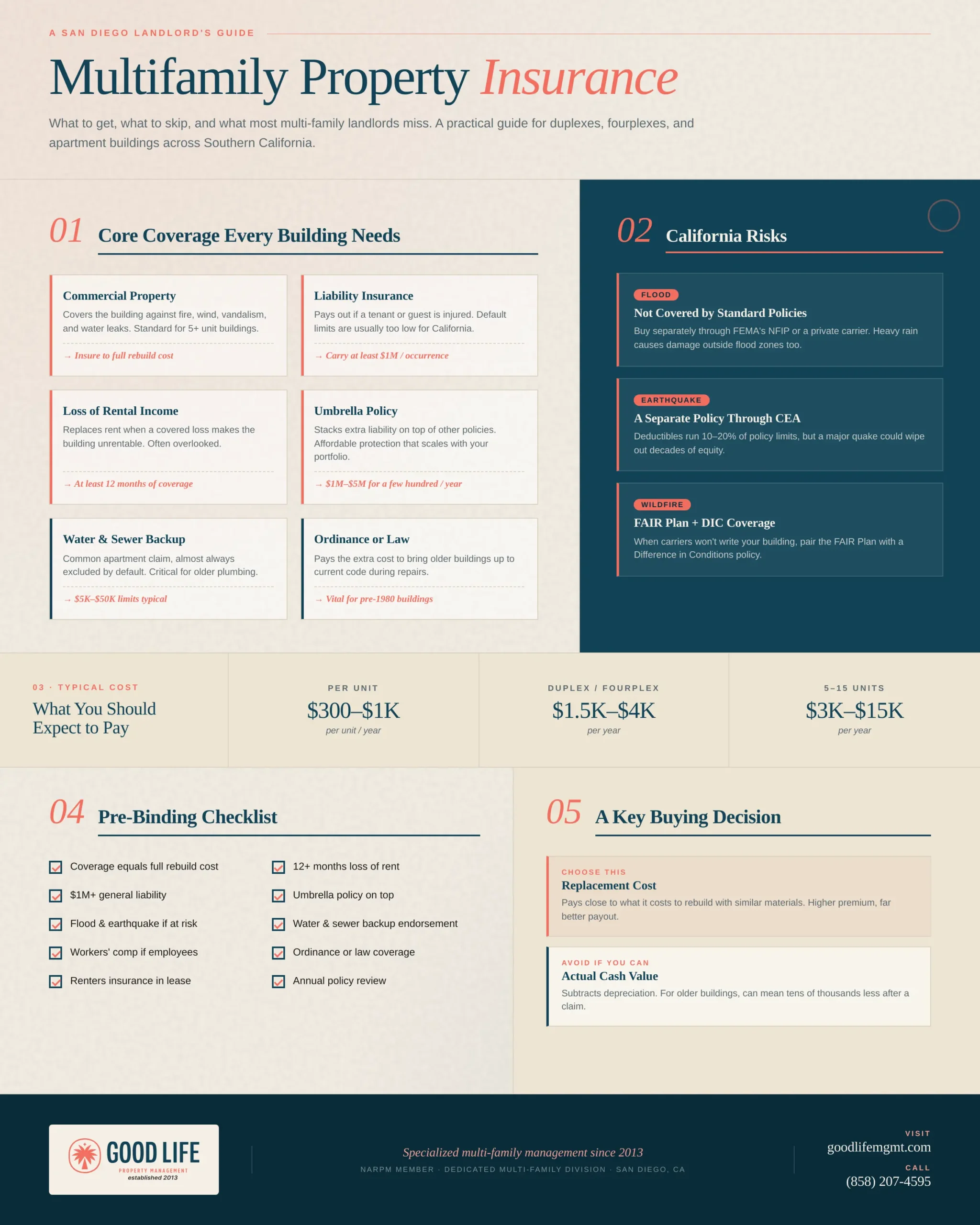
- Multifamily property insurance usually means layered coverage from several policies, not just one.
- Core coverages: commercial property insurance, at least $1M in liability, 12+ months of loss of rental income, and an umbrella policy on top.
- California essentials are sold separately: flood (FEMA NFIP), earthquake (CEA), and wildfire (FAIR Plan paired with a DIC policy).
- Don’t skip water and sewer backup coverage or ordinance or law coverage, especially for older buildings.
- Expect $300 to $1,000 per unit per year. Duplexes run $1,500 to $4,000, while 5 to 15 unit buildings typically run $3,000 to $15,000.
- Pick replacement cost over actual cash value, and require renters insurance in every lease.
Choosing multifamily property insurance is one of the most important and most misunderstood decisions a landlord can make. At Good Life Property Management, we have helped over 1,000 San Diego property owners protect their rentals since 2013. We are also proud members of NARPM (the National Association of Residential Property Managers), and we run a dedicated multi-family division for buildings with 5 to 15 units. Because of that experience, we know how confusing multifamily property insurance can be. In fact, picking the wrong policy is one of the most expensive mistakes a landlord can make. So in this guide, we will walk you through every type of coverage you should consider for a duplex, fourplex, or apartment building, including how apartment building insurance works and what San Diego landlords should look for in a policy.
For most San Diego multifamily property owners, the core insurance package should include commercial property insurance or landlord insurance, general liability coverage, loss of rental income coverage, ordinance or law coverage, and water backup coverage. Depending on the building’s location and risk profile, owners should also consider earthquake insurance, flood insurance, wildfire coverage, an umbrella policy, and workers’ compensation if they have employees.
Table of Contents
- What Is Multifamily Property Insurance?
- Types of Multifamily Property Insurance
- Replacement Cost vs. Actual Cash Value
- Multifamily Property Insurance Cost
- Best Multifamily Property Insurance: How to Choose
- Multi Property Landlord Insurance: Tips for Investors
- Should Multifamily Owners Require Renters Insurance?
- Why Insurance Matters More in San Diego
- Multifamily Insurance Checklist
- Frequently Asked Questions
- The Bottom Line
What Is Multifamily Property Insurance?
Multifamily property insurance is a policy, or a set of policies, that protects rental buildings with more than one unit. This includes duplexes, triplexes, fourplexes, and larger apartment buildings. While a single-family rental might be covered under a basic landlord policy, multifamily buildings usually need broader and more layered coverage.
For example, once your building has five or more units, many insurance companies treat it as a commercial property. That means you will likely need commercial property insurance instead of a standard landlord policy. However, even smaller buildings like duplexes and fourplexes can be insured under either type of policy, depending on the carrier.
The right mix of coverage protects you from fires, storms, lawsuits, lost rent, and many other risks. Without it, one bad event could wipe out years of returns.
Types of Multifamily Property Insurance
There is no single policy that covers everything. Instead, most landlords combine several types of insurance to build a strong safety net. Below are the main coverages every multifamily owner should know about.
Apartment Building Insurance (Commercial Property Insurance)
Apartment building insurance, also called commercial property insurance, is the foundation of most multifamily policies. It covers the building itself against damage from fire, wind, vandalism, water leaks, and similar events.
This is the same general category that protects offices and stores. However, it is tailored to residential buildings with multiple units. If your building has five or more units, this is almost always the policy type you will need. For duplexes and fourplexes, you can usually choose between a landlord (dwelling) policy and a commercial apartment building insurance policy. Talk to a licensed insurance agent to compare both.
Make sure your coverage limit reflects the full cost to rebuild your building, not just its market value. Rebuilding costs in San Diego have climbed in recent years, so review your policy each year to keep up.
Landlord Insurance for Multifamily Properties
Landlord insurance for multi-family buildings is sometimes sold as a “DP-3” dwelling policy. It is similar to homeowners insurance, but it is built for rental owners. This kind of policy is common for owners of duplexes, triplexes, and fourplexes.
In addition to building coverage, it often includes liability protection and loss of rental income. However, the limits are usually lower than a commercial policy. So if you own a larger building, or you plan to grow your portfolio, ask your agent about moving to commercial coverage instead.
Liability Insurance for Landlords
Liability insurance for landlords pays out if someone is hurt on your property or if you are sued for damages. For example, a tenant slips on a wet walkway, or a guest is injured by a broken stair. Without coverage, you could be on the hook for medical bills, legal fees, and a court judgment.
Most landlord and commercial policies include some general liability coverage. However, the default limits often are not enough. Many San Diego landlords carry at least $1 million in liability per occurrence, and some carry $2 million or more.
California also has unique liability risks. For instance, the California balcony inspection law requires owners of buildings with three or more units to inspect exterior elevated elements like balconies and decks. If you skip these inspections and something fails, your insurance claim could be denied. So stay current on the local laws for multi-family properties and keep your inspection records on file.
Loss of Rental Income Coverage
Also called “rental income insurance” or “loss of rents,” this coverage pays you when your property cannot be rented because of a covered loss. For example, imagine a fire makes your fourplex unlivable for six months. Loss of rental income coverage replaces the rent you would have collected during repairs.
This is one of the most overlooked yet most valuable parts of a multifamily policy. After all, your mortgage, property taxes, and insurance premiums do not pause just because the building is empty. Make sure your policy includes at least 12 months of rental income protection, since major repairs in San Diego often take longer than expected.
Umbrella Policy for Rental Property
An umbrella policy for rental property adds extra liability coverage on top of your other policies. For example, if your apartment building insurance has a $1 million liability limit and you are sued for $2 million, your umbrella policy can cover the difference.
These policies can be relatively affordable compared with the amount of extra liability protection they provide. Many landlords add $1 million to $5 million in extra coverage for a few hundred dollars per year. If you own multiple rentals, an umbrella policy is one of the smartest tools in your kit. It also gives you peace of mind in a state like California, where lawsuit awards can climb fast.
Flood Insurance for Multifamily Properties
Standard multifamily policies do not cover floods. So if your building sits in a flood zone, you will need a separate flood policy. The National Flood Insurance Program, run by FEMA, is the most common source. Private flood insurance is also available and often offers higher limits.
In San Diego, flood risk varies a lot by neighborhood. Properties near rivers, coastlines, or low-lying areas face higher risk. Even if you are outside a designated flood zone, heavy rains and clogged storm drains can still cause damage. So ask your agent to review your flood exposure each year.
Water Backup and Sewer Backup Coverage
Water backup and sewer backup are some of the most common claims in apartment buildings. However, standard multifamily policies often exclude this kind of damage. So if a drain clogs or a city sewer line backs up into your building, you may not be covered without this add-on.
This coverage pays to repair damage caused by water that flows backward through drains, sump pumps, or sewer lines. For example, a clogged main line could flood a ground-floor unit and damage flooring, drywall, and appliances. Without water backup coverage, you would likely pay for those repairs out of pocket.
Buildings with older plumbing or basement-level rentals face the highest risk. So if your property fits one of these, ask your agent to add water backup and sewer backup coverage. Limits often range from $5,000 to $50,000, depending on the carrier. While that may sound small, it goes a long way toward covering a typical backup claim.
Earthquake Insurance for Apartment Buildings
Like floods, earthquakes are not covered under a standard policy. Because California sits on several active faults, earthquake insurance is worth strong consideration for any Southern California landlord. The California Earthquake Authority is the largest provider, though private insurers also write policies.
Earthquake coverage can be pricey, and deductibles are often 10 to 20 percent of the policy limit. However, a major quake could destroy decades of equity overnight. For multifamily buildings, where repair costs and tenant displacement are high, this coverage is often worth the price.
Wildfire Coverage, FAIR Plan, and DIC Policies
Wildfires are one of the most serious risks for California rental property owners. Because of recent fires, many insurance carriers have raised prices, stopped writing new policies in higher-risk areas, or chosen not to renew existing ones. So if you own a multifamily building in or near a fire-prone area, finding traditional coverage can be tough.
When that happens, the California FAIR Plan can serve as a last-resort option. According to the California Department of Insurance, the FAIR Plan should only be considered after a diligent search in the traditional market. CDI also notes that FAIR Plan coverage is more limited than a standard policy. In general, it covers losses caused by fire, lightning, internal explosion, and smoke. Optional extended coverage is available for an extra cost.
However, the FAIR Plan does not cover everything. For example, it usually leaves out theft and liability. So many owners pair it with a Difference in Conditions (DIC) policy. A DIC policy fills the gaps left by the FAIR Plan, such as theft, liability, water damage, and sometimes earthquake. Together, the two policies can give you protection close to a standard commercial apartment building insurance policy.
If you are facing non-renewal or struggling to find coverage, talk to an independent broker who works with California’s high-risk market. They can help you weigh the FAIR Plan, DIC policies, and any private options that may still be available.
Workers' Compensation Multifamily Insurance
If you have any employees, California law requires workers’ compensation. This includes on-site managers, maintenance staff, or cleaners on your payroll. Coverage pays for medical care and lost wages if a worker is hurt on the job. You can learn more about California requirements at the Department of Industrial Relations.
Most small landlords use independent contractors instead of employees, so workers’ compensation may not apply. However, the line between “contractor” and “employee” is not always clear. If you hire someone on a regular basis, ask your insurance agent or attorney whether a workers’ compensation policy is needed.
Ordinance or Law Coverage for Older Buildings
Older buildings in San Diego may not meet current building codes. So if your property is damaged, you may be required to bring it up to code during repairs. Ordinance or law coverage pays for these extra costs.
This is especially important for older apartment buildings in neighborhoods like North Park, Hillcrest, and Golden Hill, where many properties were built decades ago. Without this coverage, you could face large out-of-pocket expenses after a covered loss.
Replacement Cost vs. Actual Cash Value: A Key Buying Decision
Once you know which types of coverage you need, the next big decision is how your building is valued at claim time. There are two main options, and the difference can be huge.
Replacement cost coverage pays close to what it would actually cost to rebuild or repair your property with similar materials. Actual cash value (ACV) coverage, on the other hand, subtracts depreciation. So an older roof, for example, might pay out far less under ACV than it would cost to replace.
For older multifamily buildings in San Diego, this difference can mean tens or even hundreds of thousands of dollars after a major claim. So many brokers recommend asking about replacement cost coverage whenever possible, even though premiums are higher.
In addition to choosing between these two options, ask your agent about the following details:
- Extended replacement cost. This adds an extra cushion, often 25 to 50 percent above your stated limit, in case rebuilding costs spike after a wide-area disaster.
- Building code upgrade costs. Also called ordinance or law coverage, this pays the extra cost of meeting current codes when older buildings are repaired or rebuilt.
- Coinsurance penalties. Many policies require you to insure your building to at least 80 percent of its replacement cost. If you fall below that line, your claim payouts can be reduced, even for small losses.
- Separate deductibles for earthquake, wind, or wildfire. These deductibles often work as a percentage of the policy limit, not a flat dollar amount. So a 10 percent deductible on a $2 million building means $200,000 out of pocket before coverage kicks in.
These details may seem small at first. However, they often decide how much you actually receive after a claim. So review them carefully before you sign.
Multifamily Property Insurance Cost: What to Expect
Multifamily property insurance cost depends on many factors. These include the age of your building, its location, the number of units, your claims history, and the coverage limits you choose. However, here are some general ranges to help you plan.
For small buildings like a duplex or fourplex, expect to pay roughly $1,500 to $4,000 per year for a basic landlord or commercial policy. For apartment buildings with 5 to 15 units, costs often range from $3,000 to $15,000 per year. Larger complexes can run much higher.
On a per-unit basis, premiums often land between $300 and $1,000 per unit per year. Buildings in higher-risk zones, older buildings, and those with prior claims pay more.
To keep costs down, raise your deductible, bundle policies with one carrier, install safety features like smoke alarms and security cameras, and shop your policy every few years. Working with an experienced property manager can also help, since well-maintained buildings often qualify for better rates.
Best Multifamily Property Insurance: How to Choose
There is no single “best multi-family property insurance” carrier for every owner. Instead, the best policy depends on your building, your goals, and your budget. However, here are a few tips to help you choose.
First, work with an independent insurance broker who specializes in rental properties. They can compare quotes from several carriers and explain the trade-offs. Next, ask each carrier about claim response times, since slow claims can drag out repairs and lost income.
Also, check the carrier’s financial strength rating through AM Best or the California Department of Insurance. A cheap policy is not a deal if the company cannot pay out when you need them.
Finally, review your policy every year. Rebuild costs, rent levels, and tenant turnover change over time. Your insurance should change with them.
Multi Property Landlord Insurance: Tips for Investors
If you own several rental buildings, ask about a “blanket” multi property landlord insurance policy. These policies cover multiple buildings under one contract, which can save money and simplify management.
In addition, an umbrella policy spread across all your buildings adds a strong layer of liability protection at a relatively low cost. Together, these tools help you protect a growing portfolio without juggling dozens of separate policies.
Also, do not forget about maintenance. Insurance carriers reward owners who keep their buildings in great shape. So follow multifamily maintenance best practices to lower the risk of claims and help keep premiums in check.
Should Multifamily Owners Require Renters Insurance?
Even with great coverage on your end, there is still a gap. Landlord insurance protects the building and your liability as the owner. However, it does not cover your tenants’ personal belongings or their personal liability. So if a fire damages a tenant’s furniture, electronics, or clothing, your policy will not pay them back.
That is where renters insurance comes in. A tenant’s renters insurance policy covers their belongings, often pays for temporary housing if they are displaced, and includes personal liability protection. Many policies cost tenants only $10 to $20 per month, which makes the requirement easy to enforce.
California law generally allows landlords to require renters insurance as a condition of the lease, as long as the requirement is spelled out up front. So most multi-family owners in San Diego can simply add the rule to their lease template. For owners, this brings several benefits. First, it reduces conflict after a covered loss, since tenants are not turning to you to replace their things. Second, some renters policies include liability coverage that may step in if a tenant accidentally damages a neighbor’s unit or starts a small fire. Third, requiring proof of coverage signals that you run your property like a business, which tends to attract higher-quality tenants.
To put the requirement in place, include it in your lease and ask each tenant to send proof before move-in. Some landlords also ask to be named as an “additional interest” on the policy, so they receive a notice if coverage lapses. Either way, this small step protects everyone involved.
Why Insurance for Apartment Building Owners Matters More in San Diego
Southern California landlords face risks that owners in other parts of the country do not. Earthquakes, wildfires, mudslides, and coastal flooding all add up. In addition, California has strong tenant protection laws, strict building codes, and high lawsuit awards.
For these reasons, the cost of being underinsured here is higher than almost anywhere else. So as you plan your coverage, think locally. A policy that works for a landlord in Texas or Ohio may leave a San Diego landlord exposed.
If you are new to renting in the area, our guide on renting out your property in San Diego is a great place to start. And if you are looking for hands-on help, learn how to choose a multi-family property manager who knows the local market.
Multifamily Insurance Checklist
Before you finalize your policy, run through this short checklist.
☐ Building coverage based on full replacement cost
☐ General liability coverage
☐ Loss of rental income coverage
☐ Ordinance or law coverage
☐ Water backup and sewer backup coverage
☐ Flood insurance, if needed
☐ Earthquake insurance, if needed
☐ Wildfire coverage or FAIR Plan plus DIC coverage, if needed
☐ Umbrella liability coverage
☐ Workers’ compensation, if you have employees
☐ Renters insurance requirements for tenants
☐ Annual policy review
If all of those boxes are checked, you are in a strong position. If not, talk to your insurance agent and property manager about closing the gaps.
Frequently Asked Questions
What insurance do I need for a multifamily property?
Most multifamily owners should start with property coverage, general liability coverage, loss of rental income coverage, and ordinance or law coverage. Depending on the property, you may also need flood insurance, earthquake insurance, water backup coverage, wildfire coverage, an umbrella policy, or workers’ compensation. The right mix depends on your building size, location, age, claims history, and lender requirements.
How much is multifamily insurance per unit?
Multifamily insurance per unit usually costs between $300 and $1,000 per year. However, the exact price depends on the building’s age, location, claims history, and coverage limits. For example, a newer building in a low-risk area may cost closer to $300 per unit, while an older building in a high-risk zone may cost much more. Always get several quotes to find a fair price.
How much is apartment building insurance?
For smaller apartment building insurance, such as those with 5 to 15 units, insurance typically costs $3,000 to $15,000 per year. Larger complexes can cost tens of thousands of dollars annually, depending on size, age, and location. Factors like earthquake or flood coverage can also raise the price. Working with a broker who knows multifamily properties helps you balance cost with coverage.
Do I need commercial property insurance for a duplex or fourplex?
Not always. Duplexes, triplexes, and fourplexes can usually be covered under either a landlord (dwelling) policy or a commercial property policy. However, commercial coverage often offers higher limits and more flexibility, which can be helpful if you plan to grow your portfolio. Compare both options before deciding.
Is flood insurance required in San Diego?
Flood insurance is not required by California law, but lenders often require it if your property is in a designated high-risk flood zone. Even if it is not required, many San Diego landlords still buy a policy, since standard insurance does not cover flood damage.
Does earthquake insurance cover all damage?
No. Earthquake insurance covers shaking damage from a quake, but deductibles are usually 10 to 20 percent of the policy limit. So you may still owe a significant amount out of pocket after a major event. Still, the policy can save you from total financial loss when the damage is severe.
How can I lower my multifamily property insurance cost?
Raise your deductible, bundle policies, install safety features, keep up with maintenance, and shop your policy every few years. In addition, partnering with a strong property manager can lower your risk profile, which can help bring premiums down over time.
The Bottom Line on Multifamily Property Insurance
Multifamily property insurance is one of the most important investments you can make as a landlord. The right mix of coverages protects your building, your income, and your long-term wealth. So take the time to compare policies, ask the right questions, and review your coverage each year.
At Good Life Property Management, we help landlords across San Diego and Southern California protect and grow their multifamily investments. Learn more about our owner protection guarantees and how we make rental ownership easier. If you own a duplex, fourplex, or apartment building, our dedicated multi-family division would love to help.
If you found this article helpful, follow us on social media. We post daily tips to help you manage your own rental property:







Steve Welty
Subscribe to our Weekly Newsletter
Join the 5k+ homeowners receiving Local Law Updates and Landlord Tips. Delivered to your inbox every Saturday at 6am PST.
Share this:
Get in touch with us:
Choose Your Next Step
Good Life Blogs
We believe that education is empowering.

Fall Activities to do in San Diego
There are plenty of fun fall activities to do in San Diego. Check out our list of family friendly and night on the town ideas!
Houses vs. Condos: What Are the Pros & Cons?
Should you purchase a home or a condo? These pros and cons will help you decide which type of property is the best fit for you.

Tips for an Easy Property Turnover
After your tenant moves out, you’ll need to prepare the property for new tenants. Check out these tips on how to make the turnover process quick and easy.