
San Diego Landlord Laws for Multi-family Properties: 2026 Update

TL;DR
San Diego multi-family landlords face some of the strictest rental laws in California in 2026. You need just cause to evict from Day 1, rent increases are capped at 5% plus CPI, and new laws now require working appliances, mandatory deposit photos, and post-disaster rent obligations. Staying compliant means knowing both state law and San Diego’s local ordinances and the rules keep changing every year.
At Good Life Property Management, we have spent over 13 years helping landlords navigate California’s complex rental laws. We are trusted with over 1,000 San Diego properties and were named one of the Top 100 Property Managers in America for 2025 by PropertyManagement.com.
As expert multi-family property management specialists, we know how fast the rules can change. If you own or are thinking about buying a multi-family property in San Diego, this guide is for you. San Diego landlord laws shifted again in 2025 and 2026. Staying current is not optional. It is how you protect your investment and avoid costly legal mistakes.
Table of Contents
- Why San Diego Landlord Laws Are Different From the Rest of California
- San Diego Rent Increase Laws: What You Can and Cannot Do
- The San Diego Tenant Protection Ordinance: Day 1 Protections
- No-Fault Eviction San Diego: What Landlords Need to Know
- How to Evict a Tenant in San Diego
- San Diego Multi-family Landlord Rights
- New California Landlord Laws Taking Effect in 2026
- Essential Laws Every San Diego Multi-Family Landlord Needs to Know
- Practical Tips to Stay Compliant
- Frequently Asked Questions
Why San Diego Landlord Laws Are Different From the Rest of California
California already has strong statewide tenant protections. But San Diego goes further. The city has its own ordinances that often give tenants more rights than state law alone. As a result, you need to understand both layers: California state law and San Diego’s local rules.
This is especially true for multi-family property owners. Whether you are managing a duplex or small multi-family property or a larger apartment building, the laws that apply to you differ from those for single-family rentals.
San Diego Rent Increase Laws: What You Can and Cannot Do
California's AB 1482: The Statewide Rent Cap
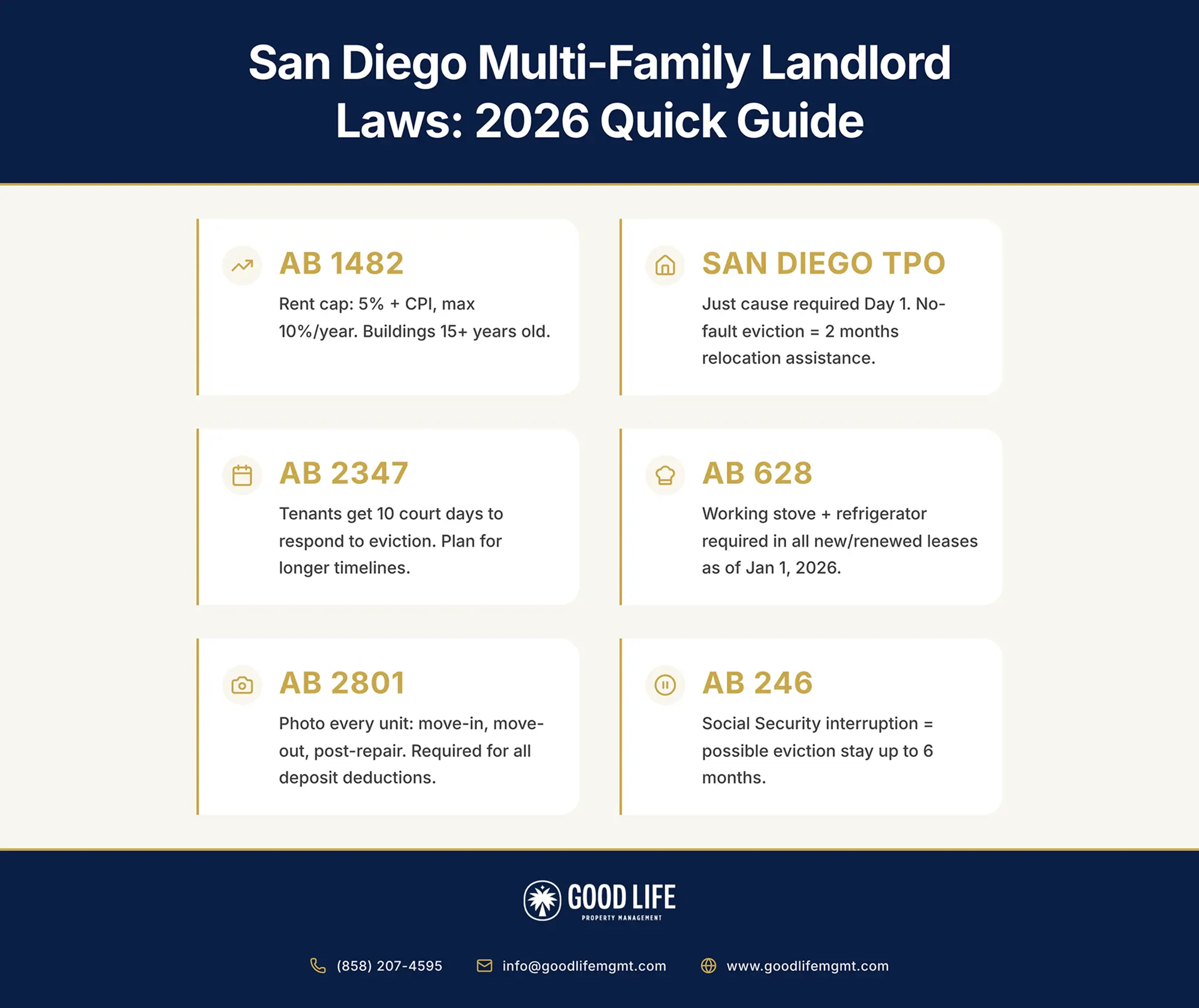
The foundation of California rent control is California’s AB 1482 Tenant Protection Act. This law limits rent increases to 5% plus the local Consumer Price Index (CPI), with a total cap of 10% per year. It applies to most multi-family buildings more than 15 years old.
If your building was constructed before 2010, AB 1482 likely applies to you. You cannot raise rent beyond the allowed amount, and you cannot raise it more than twice within any 12-month period. For current allowable percentages, refer to California Civil Code Section 1947.12.
San Diego Rent Control Rules: The Local Layer
The City of San Diego does not add a separate rent cap on top of AB 1482. However, it has stricter eviction rules that affect when and how you can raise rent in practice. Understanding San Diego rent control rules is essential before you send any rent increase notice.
San Diego also requires proper written notice. A 30-day notice is required for increases under 10%. A 90-day notice is required for increases of 10% or more.
The San Diego Tenant Protection Ordinance: Day 1 Protections
The San Diego tenant protection ordinance (Ordinance No. O-21647) went into effect on June 24, 2023. It is one of the most significant changes for San Diego landlords in recent years. Most importantly, it applies from Day 1 of any tenancy. There is no 12-month waiting period, unlike under state law.
According to the San Diego Housing Commission, the ordinance covers these key areas:
- Just cause for eviction is required from the first day of tenancy
- Relocation assistance is required for no-fault evictions (two months’ rent, or three months for seniors and disabled tenants)
- Source of income protection means you cannot reject a tenant solely for using a housing voucher
Every landlord covered by this ordinance must give new tenants a written copy of the Tenant Protection Guide at lease signing.
San Diego Tenant Protection Ordinance Exemptions
Not every property is covered. The ordinance does not apply to:
- Separately titled single-family homes not owned by a corporation, REIT, or LLC with a corporate member (if proper written exemption notice is given)
- Units where the tenant shares a bathroom or kitchen with the landlord
- Short-term rentals of fewer than 30 days
- ADUs attached to the landlord’s primary residence
Keep in mind that local ordinances vary by city across San Diego County. If your property is outside San Diego city limits, check your specific municipality’s rules.
Under the San Diego ordinance, no-fault evictions require relocation assistance equal to two months’ rent. That rises to three months for seniors (62 or older) or disabled tenants. You must also provide at least 60 days’ notice in most no-fault situations. For remodels, you must notify tenants of permit applications at least three days before filing.
No-Fault Eviction San Diego: What Landlords Need to Know
No-fault evictions occur when a landlord ends a tenancy without any wrongdoing by the tenant. Common reasons include owner move-in, substantial remodel, or removing a unit from the rental market.
Under the San Diego ordinance, no-fault evictions require relocation assistance equal to two months’ rent. That rises to three months for seniors (62 or older) or disabled tenants. You must also provide at least 60 days’ notice in most no-fault situations. For remodels, you must notify tenants of permit applications at least three days before filing.
The City of San Diego Tenant Termination Notice Registry
The ordinance requires landlords to notify the San Diego Housing Commission within three business days of issuing any termination notice. This takes effect 30 days after the Commission launches its online submission portal. According to the San Diego Housing Commission, this Tenant Termination Notice Registry is still pending City Council action. Monitor updates closely and be ready to comply as soon as it launches.
How to Evict a Tenant in San Diego
At-Fault Evictions
At-fault evictions are allowed when a tenant violates the lease. Common just-cause reasons include nonpayment of rent, property damage, unauthorized subletting, criminal activity, and refusing landlord access after proper notice. For curable violations, you must give written notice and a chance to correct the problem before starting eviction proceedings.
Can a Landlord Evict a Tenant Without Going to Court in California?
No. California requires landlords to go through the court process every time. You must serve proper notice, wait for it to expire, and then file an unlawful detainer lawsuit if the tenant does not leave. Only a court order allows the sheriff to remove a tenant. Self-help evictions such as changing locks or shutting off utilities are illegal and can expose you to significant liability.
AB 2347: New Eviction Timeline Changes
The AB 2347 eviction timeline changes took effect January 1, 2025. Tenants now have 10 court days to respond to an eviction complaint, double the previous five-day window. If served by mail, they get five additional court days. For a full overview of the court process, the California Courts Self-Help Guide on Evictions is a reliable official resource.
San Diego Multi-family Landlord Rights
While California law leans tenant-friendly, you still have important rights:
- Right of entry: You may enter with 24 hours’ written notice for inspections, repairs, or showings
- Right to enforce the lease: You can pursue at-fault evictions for any lease violation using proper procedure
- Right to screen tenants: You can set lawful criteria applied consistently to all applicants
- Right to collect rent: You can charge late fees and pursue unpaid rent through the courts
New California Landlord Laws Taking Effect in 2026
AB 628: The Appliance Mandate
Starting January 1, 2026, California requires landlords to provide a working stove and refrigerator in every rental unit covered by a new or renewed lease. The AB 628 appliance requirements amend California Civil Code Section 1941.1. A unit without these appliances is now legally uninhabitable. If an appliance is recalled, you must repair or replace it within 30 days. The California Apartment Association has published compliance guidance and updated lease forms to help landlords prepare.
California's Mandatory Balcony Inspection Law
If your building has three or more units and elevated exterior elements such as balconies or decks more than six feet above the ground, you must comply with California’s mandatory balcony inspection law. Inspections must be completed by a licensed professional on a recurring schedule. This is one of the most commonly missed requirements for multi-family owners in San Diego.
*** Click image to make it larger
Essential Laws Every San Diego Multi-Family Landlord Needs to Know
AB 2801: Security Deposit Photo Documentation (Active 2025)
This law changed how landlords handle deposit deductions. You must photograph every unit at three points: before move-in (for leases starting July 1, 2025 or later), after move-out before any cleaning or repairs, and again after work is done. Share all photos with the departing tenant along with your itemized deduction statement. There are no exemptions by property size or ownership type. Skipping this step can void your right to make deductions, even when the damage is real.
AB 246: Social Security Tenant Protection Act (Active January 1, 2026)
This law creates a new eviction defense for tenants whose Social Security income is interrupted by federal government action. If a qualifying tenant raises this hardship in court, a judge may pause eviction proceedings for up to six months. The tenant still owes all unpaid rent and must repay it once benefits resume. This defense only applies to nonpayment cases. It runs through January 20, 2029. If a tenant raises this defense after receiving a nonpayment notice, consult an attorney before proceeding.
SB 610: Post-Disaster Landlord Responsibilities (Active January 1, 2026)
San Diego landlords face wildfire and storm risk every year. SB 610 sets clear rules when disaster strikes. If a unit becomes uninhabitable due to a declared disaster, you must halt rent collection for that period. If the property is destroyed, you must return any prepaid rent covering time the tenant cannot occupy the unit. Tenants have the right to return once remediation is complete. Act quickly. This law creates firm obligations tied to disaster declarations.
AB 414: Security Deposit Refund Method (Active January 1, 2026)
This law updated how landlords must return security deposits. If a tenant paid their deposit electronically, you must refund it the same way. The only exception is if both parties agree in writing to an alternative method. For multi-family landlords using online payment portals, this is a direct operational change that needs to be reflected in your lease.
Practical Tips to Stay Compliant
Managing multi-family property in San Diego means juggling state law, city ordinances, and new legislation every year. These habits will protect you:
- Use California-specific lease agreements with all required disclosures, including the San Diego Tenant Protection Guide
- Document everything in writing, from rent increases to maintenance requests
- Screen tenants consistently using the same written criteria for every applicant
- Schedule annual property inspections to catch issues early
- Work with a local property manager who tracks law changes in real time
Frequently Asked Questions
What is the maximum rent increase in San Diego in 2026?
Under AB 1482, most multi-family landlords are limited to 5% plus local CPI, with a hard cap of 10% per year. The City of San Diego does not add a separate cap but enforces strict notice requirements and just-cause eviction rules.
Does the San Diego tenant protection ordinance apply to my property?
It applies to most rentals within San Diego city limits. Key exemptions include separately titled single-family homes not owned by a corporation (with written exemption notice), ADUs attached to the landlord’s residence, and short-term rentals under 30 days.
What counts as just cause for eviction in San Diego?
Just cause includes at-fault reasons such as nonpayment, lease violations, and criminal activity, plus no-fault reasons such as owner move-in or substantial remodel. No-fault evictions require relocation assistance.
What happens if I do not comply with AB 628?
A rental without a working stove and refrigerator is legally uninhabitable for any new or renewed lease after January 1, 2026. Tenants may withhold rent, file code enforcement complaints, or pursue remedies under California Civil Code Section 1941.1.
Do balcony inspection requirements apply to my property?
If your building has three or more units and any elevated exterior element more than six feet above ground, yes. Inspections must be completed by a licensed contractor or structural engineer on a set schedule.
Ready to Stop Managing the Complexity Yourself?
San Diego multi-family law is not getting simpler. New legislation arrives every year, and penalties for non-compliance can include eviction delays, relocation payouts, and costly lawsuits.
That is why hundreds of San Diego property owners trust Good Life Property Management. Our team of multi-family specialists stays ahead of every law change so you do not have to. Since 2013, we have managed thousands of leases, evictions, and inspections across San Diego County, making compliance our job so you can focus on your returns.
If you found this article helpful, follow us on social media. We post daily tips to help you manage your own rental property:







Steve Welty
Subscribe to our Weekly Newsletter
Join the 5k+ homeowners receiving Local Law Updates and Landlord Tips. Delivered to your inbox every Saturday at 6am PST.
Share this:
Get in touch with us:
Choose Your Next Step
Good Life Blogs
We believe that education is empowering.

Essential Tips for Preparing Your Property for the Rainy Season
There’s a famous quote that we hear often, ‘In this business, by the time you realize you’re in trouble, it’s too late to save yourself.”
As the rainy season approaches,

Top 11 Richest Neighborhoods in San Diego
From coastal luxury to gated estates, discover the richest neighborhoods in San Diego based on home value and investment appeal.

Is a Prefab ADU Right for You?
Prefab ADUs are becoming more popular throughout San Diego. Is it the right choice for your property?