
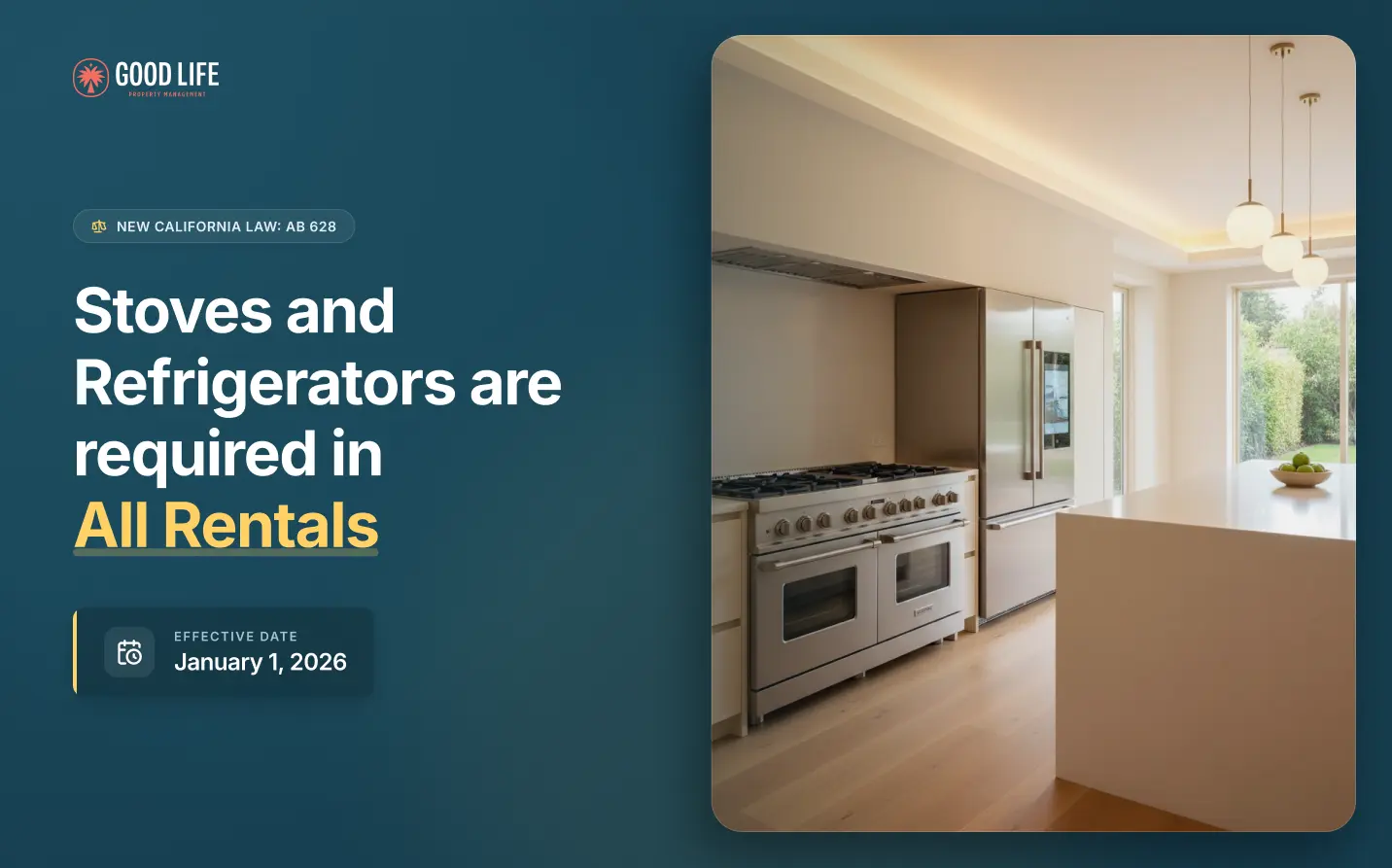
California landlords are facing a significant statewide change to rental housing law beginning January 1, 2026. Assembly Bill 628, commonly referred to as the 2026 Appliance Mandate, expands what the state considers a legally habitable rental unit. For the first time, California law will explicitly require landlords to provide and maintain certain major kitchen appliances in most residential rental properties.
This is not a local ordinance limited to one city or county. AB 628 applies broadly across California and affects nearly all residential rental properties, including single family homes, condominiums, duplexes, triplexes, and multifamily apartment buildings. Whether you own one rental home or manage a large portfolio, this law likely applies to you. For many owners, this shift also underscores the growing importance of professional property management to oversee compliance, maintenance coordination, and proper lease documentation.
Because AB 628 amends California’s core habitability statute, non compliance can create serious legal exposure. Landlords who fail to meet the new standards could face tenant complaints, rent withholding claims, habitability disputes, or potential enforcement actions. Waiting until late 2025 to prepare is not advisable.
In this guide, we will explain what AB 628 requires, how it changes existing law, which properties are covered or exempt, and what practical steps landlords should take now to stay compliant and protect their investments.
What Is AB 628 and Why It Matters
Overview of the New Law
Assembly Bill 628 is a statewide update to California landlord tenant law that expands minimum habitability requirements for residential rentals. Effective January 1, 2026, landlords must provide certain major kitchen appliances in order for a rental unit to meet the legal definition of a habitable dwelling.
Historically, California required landlords to provide essential building systems such as plumbing, heating, weatherproofing, electrical service, and hot and cold running water. Appliances like refrigerators and stoves were commonly included in rentals, but they were not uniformly mandated under state law. AB 628 changes that framework.
Beginning in 2026, most residential landlords will be legally required to provide and maintain a working stove and a functioning refrigerator. These appliances become part of the baseline standard for lawful tenancy in California.
Legal Foundation
AB 628 amends California Civil Code § 1941.1, the statute that defines when a rental unit is considered “tenantable.” Civil Code § 1941.1 sets forth the minimum conditions required for a dwelling to be legally habitable.
Under the amended statute, a rental unit must include:
- A working stove capable of safely cooking food
- A refrigerator capable of safely storing perishable food
By adding these appliances directly to Civil Code § 1941.1, the legislature elevated them to the same legal status as other habitability essentials such as waterproofing, heating facilities, and safe electrical wiring. As a result, failure to provide or maintain these appliances could render a unit legally untenantable.
What the Appliance Mandate Requires
Required Appliances
For leases entered into, renewed, or amended on or after January 1, 2026, landlords must provide and maintain:
- A working stove capable of safe cooking
- A refrigerator capable of safely storing food
These appliances must be present at the beginning of the tenancy and kept in good working condition throughout the lease term. Once the appliance becomes part of the rental agreement, it becomes the landlord’s responsibility to maintain it, unless a lawful written agreement states otherwise under specific permitted conditions.
Condition and Recall Obligations
The obligation extends beyond simply placing an appliance in the unit. Landlords must ensure that the stove and refrigerator are in safe, working order.
If an appliance becomes subject to a manufacturer or public agency recall, the landlord must repair or replace it within the time frame required by law, generally within 30 days of receiving notice of the recall. Ignoring recall notices could expose landlords to safety liability and habitability claims.
Routine maintenance and prompt repair of malfunctioning appliances will become part of standard property management practice after 2026.
Tenant-Provided Appliance Option
AB 628 allows tenants to provide their own refrigerator under limited circumstances. If both parties agree at the time of lease signing that the tenant will supply the refrigerator, that agreement must be in writing and included in the lease.
The lease must contain clear language documenting:
- That the tenant is voluntarily providing the refrigerator
- That the landlord is not responsible for maintenance or replacement of that specific appliance
Without proper written documentation, the default assumption may be that the landlord is responsible. Clear lease drafting will be critical.
How AB 628 Changes Rental Habitability Standards
Expanded Habitability Definition
California habitability law has long required landlords to provide basic infrastructure and utilities. AB 628 expands that definition by elevating kitchen appliances to the same level as plumbing, heating, and electrical systems.
By codifying stoves and refrigerators within Civil Code § 1941.1, the law makes these appliances a non optional component of a legally compliant rental unit. This represents a meaningful shift from past practice, especially for landlords who previously rented units without refrigerators.
Risk of Non-Compliance
If a rental unit lacks a required appliance, or if the appliance is not functioning properly, the unit may be considered untenantable under California law.
Potential risks include:
- Tenant repair and deduct claims
- Rent withholding
- Habitability lawsuits
- Local code enforcement complaints
- Increased liability exposure in the event of injury or property damage
Because habitability standards are closely tied to tenant rights, failure to comply with AB 628 could have financial and legal consequences far beyond the cost of the appliance itself.
Who Is Affected and Who Is Exempt
Covered Properties
AB 628 applies statewide to most residential rental units in California, including:
- Single family homes
- Condominiums and townhomes
- Duplexes and triplexes
- Multifamily apartment buildings
If you are renting out residential property for dwelling purposes, the law likely applies.
Exemptions
Certain housing types may be exempt, including:
- Permanent supportive housing
- Single room occupancy properties with communal kitchen facilities
- Residential hotels
- Other housing arrangements where individual units do not include private kitchens
Landlords should carefully review their property type and consult legal or professional guidance if they believe an exemption may apply.
Practical Steps for California Landlords to Prepare
Unit Audits and Inspections
Landlords should begin by auditing their current rental units. Confirm that each unit has:
- A functioning stove
- A functioning refrigerator
- Proper electrical capacity and ventilation to support safe operation
Document the condition of each appliance and identify units that require upgrades.
Lease Language Updates
Existing lease templates should be reviewed and updated to:
- Reflect landlord responsibility for required appliances
- Include proper language if tenants provide their own refrigerator
- Address recall compliance procedures
Clear and precise lease drafting will reduce disputes and confusion.
Documentation and Recordkeeping
Maintain detailed records for each appliance, including:
- Manufacturer and model number
- Installation date
- Repair history
- Recall status
- Move in inspection documentation
Strong documentation helps defend against habitability claims and demonstrates good faith compliance.
Budgeting and Maintenance Plans
Landlords should budget now for:
- Appliance purchases
- Installation costs
- Future replacements
- Ongoing maintenance
Older properties may require electrical or cabinetry upgrades to accommodate compliant appliances.
Financial and Operational Impacts for California Landlords
Direct Costs
The most obvious impact is the cost of purchasing and installing appliances in units that do not currently include them. Costs will vary depending on property type, appliance quality, and installation complexity.
Additional costs may include:
- Delivery and removal of old appliances
- Electrical upgrades
- Permit fees where required
Long-Term Ongoing Maintenance
Once appliances become required habitability features, landlords absorb the lifecycle management cost. This includes:
- Repairs
- Replacement at end of useful life
- Compliance with recalls
- Emergency service calls
Over time, these operational costs should be factored into long term investment planning.
Lease Negotiation Considerations
Landlords may consider adjusting rental pricing to reflect increased operating expenses, while remaining compliant with local rent control rules and notice requirements. Any rent adjustments must follow applicable state and local regulations, including AB 1482 where applicable.
How Professional Property Management Can Help
Compliance Support
Professional property managers can assist with:
- Auditing units for compliance
- Updating lease documents
- Coordinating appliance installation
- Monitoring regulatory updates
Having experienced oversight reduces the risk of overlooking critical details.
Risk Mitigation
Property managers stay informed about changes to California Civil Code § 1941.1 and related statutes. Ongoing monitoring of legal developments helps landlords avoid costly mistakes.
Operational Efficiency
Established vendor networks allow property managers to:
- Source appliances at competitive pricing
- Schedule installation efficiently
- Track maintenance and recall notices
- Respond quickly to repair requests
This operational structure can significantly reduce compliance stress for landlords.
Frequently Asked Questions About AB 628
What appliances are required under AB 628? A working stove and a functioning refrigerator are required for most residential rental units beginning January 1, 2026.
When does AB 628 take effect? The law becomes effective on January 1, 2026 and applies to new, renewed, or amended leases executed on or after that date.
Does AB 628 apply to all rental properties in California? It applies to most residential rental units statewide, with limited exemptions for certain housing types such as properties with communal kitchens.
Can tenants provide their own refrigerator? Yes, if both parties agree in writing at lease signing and the lease clearly documents that the tenant is responsible for the appliance.
What happens if an appliance breaks mid lease? Because the appliances are part of habitability standards, landlords are generally responsible for timely repair or replacement unless a valid written agreement states otherwise.
Conclusion
Summary of Key Takeaways
AB 628 significantly changes California rental law by adding stoves and refrigerators to the state’s core habitability requirements under Civil Code § 1941.1. Beginning January 1, 2026, most landlords must provide and maintain these appliances in order for a rental unit to be legally tenantable.
This law affects nearly all residential rental properties across California. Non compliance may expose landlords to tenant claims, enforcement actions, and financial risk. Early preparation is the best strategy.
If you own rental property and want help preparing for the 2026 Appliance Mandate, Good Life Property Management can assist with compliance planning, lease updates, inspections, and long term operational strategy. Proactive planning today can prevent costly disputes tomorrow. To learn more, schedule a call with one of our experts today.







Steve Welty
Subscribe to our Weekly Newsletter
Join the 5k+ homeowners receiving Local Law Updates and Landlord Tips. Delivered to your inbox every Saturday at 6am PST.
Share this:
Get in touch with us:
Choose Your Next Step
Good Life Blogs
We believe that education is empowering.

Service Animals & Emotional Support Animals: What Landlords Need to Know
There is a lot of confusion surrounding service animals, emotional support animals, and housing regulations. We’re here to explain how these support animals affect your rental property.

The 5 Ways Real Estate Pays
Here are the five distinct ways real estate can build your wealth: Cash Flow, Appreciation, Tax Savings, Amortization, and Leverage.

Essential Tips for Preparing Your Property for the Rainy Season
There’s a famous quote that we hear often, ‘In this business, by the time you realize you’re in trouble, it’s too late to save yourself.”
As the rainy season approaches,